How aligned are you to your customer’s cultural beliefs. Is your business approach and branding aligned with your target market. Do they get what you are about?
Amongst the many things, I do I am a mentor and career coach for senior people in the FinTech industry. I have recently been coaching a senior salesperson who went through a lengthy interview process with one of the world’s leading advisory companies. My client is Italian with bells and whistles on, he speaks with his hands, his heart, and passion, at a speed that makes it difficult for his interviewers to grasp what he is saying.
Essentially, he is speaking Italian but using English words. When asked a question he spends 600 words on the answer while his English and American interviewers are looking for short & concise responses of 30-50 words only. This is a classic clash of cultures and a lack of understanding on both parts – not a recipe for success. I spent hours teaching/rehearsing with him to deliver his impassioned outlook into short, natural, and passionate ‘elevator’ statements that native English speakers.
HOW DOES THIS APPLY TO YOUR BUSINESS?
I recently advised a small start-up here in CM where we agreed that their target market is not aligned with the vision they have set for their business.
They are looking at a customer segment that won’t get the value of their core business objectives. This means that this is a very hard sell for them to grow any form of sustainable business.
Think of your business branding, the story you tell about yourself and your business. Now think of your target customers, do they understand your vision, does it resonate with them, and will your vision drive them to buy your product?
If the answer is no, then what do you need to do? Well, there are 2 options open to you, one is to change your message/business to resonate with your target customer, and the other option is to target the customer market that resonates with your message and address your marketing to that market.
Are you a Thai company selling to a foreign market, or a foreign company selling to a Thai market? You should always drive your product, branding, and marketing efforts appropriate to the buyer not to what you think.
Think about it this way: if you are selling white flowers in a market where they are only used for funerals. Then you better have lots of funerals or you will not be selling a lot of flowers.
Fraud is an ever present danger to all businesses whether small or big. When it happens you are shocked, then you realize that you have no plans or back-ups in place. Fraud, whether external or internal, more often than not has a huge impact on your business. It comes in many guises: a hack into your computer network, internal theft, a computer virus, Phishing, ransomware, identity theft, etc.
“It’ll never happen to me, we are too small to be targeted, we don’t have anything of value to steal”
WRONG!! The one sure thing is that you will only take your SMEs security seriously after you have been hacked.
A Norton survey from 2021 found that:
53% of adults admit they don’t know how to protect themselves from cybercrime
38% of consumers have never considered their identity could be stolen
83% of consumers want to do more to protect their privacy, but 47% don’t know how
And a LastPass survey in 2021 found that:
41% of people don’t think their accounts are valuable enough to be worth a hacker’s time
Big companies spend a lot of money on cybersecurity to protect their assets. I recently gave a talk at a financial services event on banking fraud – a whopping 42% of reported bank fraud is actually internal fraud. In 2020 internal fraud was reported to be a total of USD 3.6 billion, but sadly banks don’t report internal fraud unless it becomes public, so the true number is deemed to be much higher.
The thing to remember is that it’s not always an anonymous hacker that impacts your business.
We all remember the ILOVEYOU worm that a student from the Philippines sent out 20 years ago. This first global bug turned out to be much worse than just a self-propelling chain letter. As it was replicating itself, the ILOVEYOU worm destroyed much of the victim’s hard drive, renaming and deleting thousands of files. The estimated impact to businesses large and small was USD 8 billion and the cost to secure businesses against future attacks was estimated to be in the region of USD 10-15 billion.
This worm didn’t care if you were a small business or the world’s largest bank it just spread.
It’ll never happen to me
Statistics show that this is a wholly wrong assumption. The world is ever more connected and the chances it will happen to you or your business are very high. We all hear stories about company A or B who got attacked for ransom, or money stolen from their accounts.
One such SME, a new client of mine, has for the past 10 years been held hostage by an unscrupulous web hosting service provider they trusted to look after them. We are in the process of building out a completely new website and implementing security processes for their business. This is just a small company of little interest to most people and yet this business has been subject to ransom demands, denied access to its email server, and not able to control its domain ownership.
We are too small to be targeted
According to a 2019 report done by OnTimeTechnology 31% of all cyberattacks today are designated for smaller entities such as individuals or small businesses.
Big businesses take cybersecurity very seriously, not wanting to become the next victim in this cyberwar. These companies invest in sophisticated cybersecurity and backup systems, protocols, and processes to protect them in the case of an attack. This means SME companies who are focused on other things become easy pickings for cyberattackkers.
We don’t have anything valuable to steal
That may be so but you have a business reputation to secure. You deliver goods or services to your customers. Any impact to being able to do this will have an impact on your revenue stream and your ability to sell in the future. You might have customer data, bank account data, and sales reports that can be used to take your customers away from you or even used to blackmail you. The reality is that we all have something of value that we need to secure.
Securing your business
The majority of people and SMEs hardly ever change their passwords, use simple ones that are easy to hack, and have them written on a yellow post-it on the computer screen or written on a piece of paper in the top drawer of their desk. No firewall, no security protocols in place. None or only partial back-ups are undertaken, no security reviews, and zero training for their staff on how to stay secure. Even if you need to save on costs, there are things you must do to take precautions.
Building a robust Security Policy
The first thing you need to do is conduct a review of your infrastructure, your networks, your protocols, and processes. Create an overview of who has what access to which systems and files, then do a risk assessment for your business as a whole. Once you know what you have, you need to create a policy for your company’s security. Train your staff on how to stay vigilant and what they need to do to stay safe.
Free tools to help you
There are many available free tools and apps available today, that have solid security protocols in place. Make use of these apps and services. Put as much of your data as you can in a secure cloud. Make sure the computers your staff uses are secure, even if it’s not your computer. Put someone in charge of security, organize some training for them and monitor that your security protocols are followed.
Starting up a business requires many decisions as you build it up. One of those decisions is whether to create a website and most crucially, what it should deliver to your business.
Many businesses elect not to create a website citing effort, cost, value derived from it. They are doing ok to transact on Facebook, TikTok, YouTube etc, and see no need for a website. Others go all out and create huge websites with masses of information.
Whatever your views, informed decisions drive better business so it’s good to consider your options.
There are 3 main types of websites 1) lead funnel to your product 2) a Business Card and 3) a reference site. Under these there are multiple sub-types such as media, blogs, educational, streaming, crowdfunding, e-commerce, communities etc.
Let’s look at the 3 main headings:
Lead funnel – here you are using your website to funnel sales of your product. This could be an e-commerce site selling soap, food, apparel, spare parts etc. It can be a multi-product site such as Amazon, Lazada, Etsy or Alibaba. It can also be a site that sells services or software such as Microsoft, Infosys, KPMG, Hilton Hotels, airlines.
Business Card – this is a more static website presenting your team, products etc. People go check out your website but essentially do no business via the site. This could be a specialist or niche product, or service. Your customers come from a different funnel but seek out your website to validate that you are a legitimate business.
Reference sit – this is Wikipedia, a knowledge store, a local community or focus group, a sports group, a chess, or bridge club. It can be open like Wikipedia or a closed membership-based site where you log in to access information.
Before you sit down to design your website you need to have a long and deep conversation with yourself to set some clear objectives on what you want to get out of your website. Only then should you define the approach, content, and create your customer’s journey on your website.
If you are building a lead funnel then your approach is to have a dynamic site with frequent updates, 600+ words per page, fully SEO styled. You need to actively market the site on Google and on social media, maybe even on mainstream news sites. You should capture email addresses by offering newsletters, product updates etc.
If you are selling your product online via the site, you will need dynamic pages and payment gateways that function seamlessly for the ultimate customer experience. You must make it easy for your customer to use your website. Their positive experience provides you with repeat business, referrals and 4 – 5 star service ratings.
If you are building the website as your Business Card, then you need to define the message you want to present to the world. You need a landing page to create the overall impression of what your business does, a couple of pages with additional information on your expertise, perhaps a blog or a page with white papers and a contact page/section. The objective is for people who have heard of or met you to validate that you are a legitimate business. The site needs to be maintained and updated from time to time.
If you are building a community site, then you need to have frequent updates to stay relevant to your audience. Manage events, insights, discussion forums etc. creating membership value to keep them engaged. You might have member-to-member offers and discounts or group relevant offers from 3rd parties. This can be paid or unpaid marketing as befitting your group. Your website should have landing page with information on the group and links to sign up. Then behind the login pages and data that are dynamic and provide a great member experience.
As you work through your ideas and views check out other websites related to your business segment to see what you like and don’t like. Maybe even sign up as a member or leave your email to see what kind of updates they offer.
When you have defined your direction then the hard work starts on finding the right people or company to help you bring your website to life. You also need to have plans in place on how to maintain the website and appoint someone to manage it all for you – that is unless you are a solopreneur, in which case I would still outsource it to someone on a part time basis to maximise the use of your time on things only you can do.
Today people want to experience things, it’s not enough to own a cool car or get a cool haircut. You can buy or get either of those anywhere, so business owners need to differentiate themselves by creating exiting, pleasing, and interesting ‘customer journeys’ that brings them back to their business again and again.
Customers want to feel loved and appreciated. They will return to the shop, bar, restaurant, hotel etc. that welcomes them, provides a unique experience, and listens to their specific needs.
As a business owner you need to spend time listening to your customers and review their reactions to you, your product, and your staff. Social media being what it is, we all know how a series of bad reviews can take their toll on any business.
The customer journey really does begin at HELLO, whether that is at your shop door, FB page, website, phone call, email etc. It’s all about how customers feel during and after interacting with your products, employees, channels, and systems.
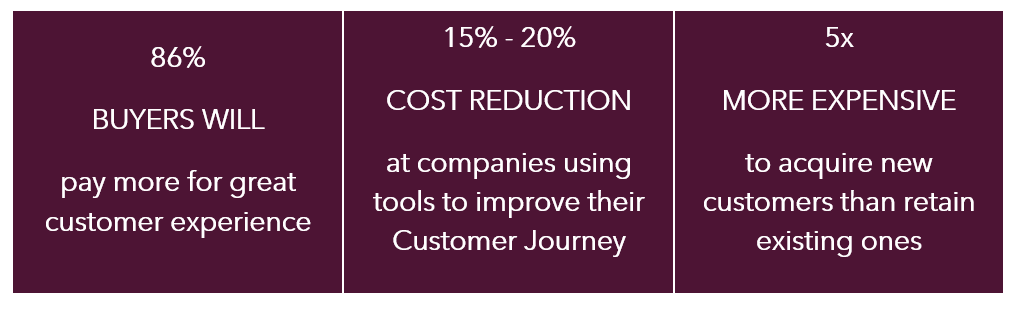
According to Forrester research:
Let’s look at how you can create a winning customer experience for your business.
First some basic principles:
People prefer simplicity over complexity
People love choice — but not too much
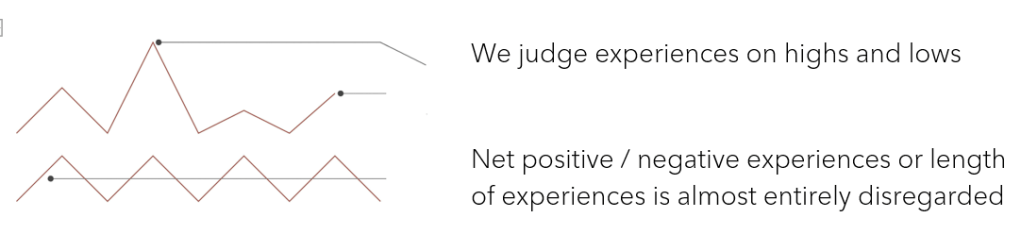
People only remember an experience based on its peak and its endpoint
People prefer relevant, personalized messages
People are scared to try new things — unless everyone else is doing it too
Everything people do is based on emotions. Even if they think they are taking a process approach to a decision. In the end the decision on using your product or visiting your shop, website is based on experiences they have had with you.
*Jenifer Clinehens Behavioural Science and Psychology
As you can see from the figure above you need to provide highs for customers. If a low happens then the experience is all about how you solve the problem for them. If that fix is inclusive and makes the customer feel valued, you have turned a low to a high.
The next step is to map out your customers. Where do they come from, age group, interests, how do they consume your product, how do they obtain it etc. Then you need to take a walk in their shoes. To understand you need to experience the same journey they take to buy/consume your product.
You need to map out all the steps it takes to do this. For example, if you have a restaurant then walk through your customers arrival at the door. How are they greeted, does someone seat them, what happens at that stage, list and evaluate all steps from HELLO to when they leave the premises waving goodbye.
Having listed all the steps, you now need to evaluate how you specifically want each step to go for your customer. You should also spend some time observing how your customers experience your service/product today. Then compare that with what you expect. Finally create a detailed SOP based on this and train all staff to follow it.
Some final points on best practice when building your Customer Experience
Customer First – actually putting yourself in their shoes
Empathy for your Customer – adopt an ‘outside-in’ approach
Efficiency – solving your customers problems and needs
Continuity – don’t disappoint, meet, and exceed expectations
A holistic approach – build with intention, considering your customers touchpoints and tasks
Agile – with flexibility be planful and purposeful for as far down the pike as you can see.”
Wondering about how to grow your business? Expand with more people at your current location, open new branches in other districts or cities. Perhaps you have wondered about turning your successful business into a franchise.
Growing your, already successful, business by creating a franchise can be a very rewarding endeavour to achieve exponential growth. If you are looking into the possibility of turning your business into a franchise, then read on.
A Franchise is
a contractual business model or relationship whereby an established brand, known as the ‘Franchisor,’ allows an independent business owner, or Franchisee, to use its branding, business model, and other intellectual property
What can be franchised
Just about anything can be franchised. From schools, yoga studios, cleaning companies, maths tutoring, pharmacies, bakeries, cafes, bicycle shops, apparel shops, spa’s, cosmetics, travel agencies, support services, dentists. If you have a good brand with an IP that is selling well, then you can franchise your business. If there is a consumer whether B2B or B2C it can be franchised.
Some of the franchises I have been involved with were in pest control, street food vendors, bioplastic manufacturer, green cleaning company and eco-cleaning products company.
Who is who in the franchise business?
The Franchisor: they own the brand, the IP, product development, and business strategy. They set the tone, operate most of the marketing, design store fronts, interiors, and uniforms. They control pricing, SOPs and standards delivered. They own all social media and branding channels. They own the procurement and manufacture of products sold or serviced by their Franchisee’s. They offer various types of franchises to these partners:
The Franchisee: buys the right to operate and sell products from the Franchisor. They manage the day-to-day operations of the Franchisor’s brand in accordance with the SOPs and contractual agreements between the parties.
The Hub Franchisee: they contract the rights to operate and manage a number of sub-Franchisees. They could own all franchises for a country, a province, a city, or a business segment within or all of the aforementioned. For example, they could own the hotel segment for a district or country and mange sub-Franchisees for that business.
The Manufacturer: they manufacture your product under license, they market and sell the product in an agreed region or territory or to a specific business segment.
The financial model
Set a good fee structure that is consummate with your Franchisee’s earnings potential. Don’t price yourself out of the market, be realistic. You want to make sure that the business offers a good income for the Franchisee. If you have priced yourself out of the market, you won’t get any takers. Do some research on what other companies charge. Fees can be broken down into several elements:
Franchisee fee: This amount can vary, depending on the franchise. The average amount can be anywhere from $20,000 to $500,000. For niche recognised brands it can go into the millions. It all depends on your franchises earning capability. This fee is due on signing the Franchise Agreement.
Start-up costs: There are a variety of expenses associated with getting a new franchise going. These can include furniture, fixtures, decor packages, marketing costs, POS software, construction and architectural costs, promotional campaigns and more. Other costs could include inventory, equipment, insurance, employee training, business licenses, rent, landscaping, signage, etc. These need to be fully declared in the Franchise Agreement.
Royalty Fees: These fees, paid monthly to you the franchisor, are based on a percentage of their franchise revenues. They can run from 4% up to as much as 12% or more, depending on the type of franchise business you are running. Make sure you have increase clauses in your Franchise Agreements.
Types of franchises
There are various forms of franchises, with the most common form of franchise being the Business Format where a Franchisee buys the right to operate and sell under the franchisors business model. This would be a Starbucks, McDonalds, Kumon Maths, or Old Town.
You can outsource the production of your products via a Product Franchise, or you can license your business via a Master Franchisee who then manages a region, territory or business segment with sub-Franchisees owned and managed by them. Here is a description of the most common forms of franchises:
Business Format: In a business format franchise, an individual can buy and operate a business with an established brand name like McDonald’s. Under this model, the new business owner will be supported throughout the initial business stages and for as long as he operates the franchise. The Franchisee benefits from your company’s business plan, operations documentation, branding and marketing.
Master: this involves a franchise known as the Master Franchisee recruiting their own Franchisees in a specific territory. The Master Franchisee recruits, trains, and provides support to the lower Franchisees. In exchange for their efforts, the Master Franchisee will take around 50% of the initial franchise fee and royalties paid by the lower Franchisees.
Manufacture: Under a manufacturer franchise model, the Franchisee has exclusive rights to produce and distribute a product in a specified geography for all or a specific business segment. Manufacturer franchises are mostly used in F&B ventures. The model can be used for any product that needs to be manufactured.
Product: Product franchises allow for dealers to distribute goods for a manufacturer. The dealer pays a fee for the ability to sell and market these trademarked goods, which are also purchased directly from you. In some cases, the Franchisee doesn’t have to pay a fee but must instead sell a minimum amount of products. The simplest example of this is a car dealership that specializes in one brand of vehicles.
First considerations when franchising your business
The key thing to remember is that your business must be a successful one. A booming business with a recognised brand attracts serious Franchisees. No one wants to buy an idea of how you will build up your business and franchise process, they want to invest in a thriving business. Further, if your business is struggling, a franchise model will not help you fix your problems. You need to fix this before you embark on transforming your business.
If you are ready then, you need to make changes to your company to fit a franchise model. You will need to have all the processes well in place in your own business. You must have detailed SOPs (Standard Operating Procedure) in place which you have thoroughly tested. You do not want to have to adjust the objectives, product, branding etc whilst you are out selling franchises.
Strategic decisions
Now you need to think about how big you want this business to be. This will determine the steps and investments you will need to make as you build the Franchise model. Do you want to be local and have maybe 5-10 Franchisee’s or are you looking country wide with more than a 100 Franchisee’s signed up. Do you want to go cross border into new countries?
How are you planning to divide up your business into segments? For example, a Pest Control Franchisee I worked with, the owner had segmented their business into Hospitality, healthcare, education, commercial and domestic. As the rules and approaches were different for hospitals or schools and kindergartens versus offices and homes. They then further divided the country (population of 77 million) into regions then subdivided into territories within the business segments. So, they could have multiple Franchisees in one city all servicing different business segments.
You will need multiple strategies in place for how you will run your franchise business such as a Sales and Marketing strategy and a Franchise Acquisition strategy. You will also have defined operational strategies for your Franchisees on their customer acquisition strategy, sales strategy, hiring strategy etc.
The commitment between the parties
You need to be fully ready to roll out the business before you engage with anyone interested in running a franchise for you. This is not an ‘I’ll develop it as I go along’ type of business.
You must have all elements down on paper, fully tested and ready to roll out. Your Franchisee is investing their hard-earned savings or may have borrowed money from family and friends to do this.
This places and obligation on you to choose the best person for the business. You must afford them the utmost of support from your side. You cannot change business processes mid-flight, nor can you change your commitments without notice.
The Franchisee conversely has an obligation to fulfil the deliverables as agreed between you. This can be staff related, revenue and sales commitments. Payment commitments, brand commitments.
Both parties will have a series of commitments that must be met for this work well. It is the Franchisor’s responsibility to ensure all of this happens. All of this should be clearly detailed in the Franchise Agreement.
Your first steps towards franchising your business:
the business must be fully operational
there is a recognised brand
a team ready to manage the original store so you can concentrate on the Franchisee’s business
marketing strategy and plan in place
sales team ready to find the best Franchisee’s
training team in place
start-up support team in place
purchasing and price agreements are in place with vendors for the premisses set up
all legal document and agreement templates are ready
SOPs created and tested by your existing team
created a new legal entity as owner for the franchise
registered trademarks, IP, brand, and patents under new entity
In summary
There are a multitude of elements to making your franchise business a success. The overriding mantra from the Franchisor must be full control over all aspects of the business. Contracts, SOPs and a crystal-clear understanding and acceptance of how the partnership is to work between the Franchisee and the Franchisor are the key elements to your success.
The following elements are key to running your franchise business:
you have a known brand and successful business. A business that is portable to other locations and even countries.
it requires a level of control in the way the businesses are run.
it requires a high level of trust in the people with whom you sign a Franchise Agreement.
very clear and understandable contracts that sets out the obligations and responsibilities of both parties.
clear SPOs which both parties must follow.
You need to be sure that the Franchisee is willing to follow your SOPs. Being told how to run a business is not everyone’s cup of tea. On the one hand you want people with experience. They have that and then want input and add ideas into how the business is run. This point is key to success. You must ensure that you take your new Franchisee on scripted learning journey.
Train the new owner well, make them understand your business model. Get them to buy in to your way of doing things. Then train their team on how to work in the business. There is cost involved but you must do it or the whole thing will collapse, and your brand image will be impacted.
Finally, don’t do this alone, get expert help and advice on how to transform your business. Make sure you are comfortable with the level of control required to run your Franchise business. Be super focused on everyone following the guidelines. Be 100% clear on objectives and targets. Never allow the Franchisee’s to change or dilute your brand identity or image. Do all of this and you will have embarked on an exciting new chapter for your business.
By now everyone has understood that posting an event, discount, product on their FB page only works if someone actually sees it. FB have convoluted rules about which people, pages, group posts you see thus reducing the number of people who see your post. This means they must actively go looking for your page to find your product or service.
You can create a page or a group on FB and people can follow this. Still does not mean that they actually get to see your post. In my experience your FB feed is populated with 20 or so of your most viewed feeds. This means that if you, like I do, follow https://www.facebook.com/weffrancais and you engage with it regularly it will filter to the top of your feed. If you don’t engage with the page, it will drop below the 20 and you will occasionally see some posts till finally it hardly ever shows up on your feed. One fine day you will suddenly remember hey I haven’t seen any posts from WEF and wonder what they are up to.
In response to this filtering people started joining interest groups with the aim of posting advertising for their products. This is where the spamming comes in as suddenly the Living in Thailand FB group got inundated with advertisement for things completely unrelated. The discussion forum was hijacked by companies spamming them. This puts off group members, so moderators put on approval gates and declined many of the adverts. Group administrators then added group rules stating no spamming or advertisement. Many groups became quite militant with regards to adverts.
For FB this a desired outcome as it helps drive us to use their paid promotions. If you pay for FB advertisement you get your posting listed on your chosen demographic prospective buyers feed. But wait, didn’t I tell you at my marketing workshop that 65% of consumers don’t trust advertisements and 71% of people have no faith in sponsored posts on social media. The general consensus is that ads are bad. The product could be great and just what you never knew you needed. However, 71% of people won’t look at it, let alone buy it because it’s a sponsored ad.
So why do people hate ads? Ads have always been with us, in newspapers, magazines, clay tablets, posters and billboards. Radio and TV initially started out with a license fee and no ads interrupting your enjoyment of Hawaii Five-O or The Archers. My theory is that when non state entities could finally purchase licenses to operate TV stations, they did not get state funding and so had to rely entirely on license fees. To stay competitive their license fees could not be more than the state funded media offered.
Which meant to become a profitable media company they had to sell ads. They sold airtime within the program time and now earned really big bucks. As a consumer all you saw was that just as they were about to discover the dead body, or Reth Butler carry Scarlett off to Tara a Coca Cola or Marlboro add interrupted your enjoyment.
Now then, what can you do to avoid spamming and still promote your product successfully. You want your product and service out there. You want people to know about it, build a good customer base, get noticed and recognised. Here are some tips for you.
Use FB groups to get engagement – choose the right group for your engagement, don’t promote meat in a vegan group, alcohol in an AA group, or Danish pastry in a forum for diabetics. I am building an experience holiday for Taylor Lam’s 333 Shooting Range. This will be a 007/Rambo style survival week. Now I am not an expert, so I asked in a Danish FB group here in Thailand what people thought about the idea. 25 constructive responses and 1 stupid comment. They were helpful, interested and had great suggestions about it. 40% were ex-military and wanted to try it out, 2 were travel agents who want the tour on their books. My next step is for a follow up post on progress and what we have decided, again asking questions looking for feedback. The post was viewed and liked by 500 people.
YouTube is a great channel for your sales. You should create informative and entertaining videos. How is your product made and how is it used. How do you get it to your customers, provide tips and knowledge. Make them short and informative. If you sell organic eggs and have 500 chickens. Video them, give the egg-layers inventive names. Talk about the feed they are given, the impact on chickens having to lay eggs. Maybe massaging the chickens has a beneficial effect, give them aroma therapy, play opera or other music that makes them lay more eggs. Have a webcam people log into to see what your chickens are up to.
Billboards are a great way of making you noticed. For some reason it’s not seen as invasive. Many years ago, I was in Robertson Valley, South Africa. On the highway there was a huge sign that simply said ‘Please don’t hoot your horn 3000 chickens resting’ That was back in 1998 and I can still see it in my mind. You need to make an impression.
Events are a great way to get your product out to an audience. Maybe it’s a market stall or you approach a venue to co-host, you can sell sponsorship for others to join you. Maybe it’s a made in Chiang Mai Sunday market. Get an influencer to talk about your product and event. One thing to promote is getting people to click the interested button or of course the going button if they are going. This shows up in their friend’s news feed that so and so is interested/going to this event.
Now think about this – I posted this article giving my take on spamming and how to market your product differently. I have shared my insights freely; you now regard me as a person of knowledge on the subject of effective marketing ideas and channels. You like what I wrote, you want help to develop some inspired marketing for your product – so who are you going to call?
I also told the story about the experience that Taylor is building. You now know that he will have this amazing 007/Rambo experience. You are interested in this, and you reach out to Taylor to know more.
This is the power of informative content. People want experiences either directly or vicariously. Tell a story that interests, amuses, and engages people. That is the way to build a good following and loyal long term customer base.
Start 2022 off on the right track. There just doesn’t seem to be enough hours in a day if you are a small business owner. Your to-do list just keeps growing longer and longer. Most items seemed important as you thought of them but in reality, the majority of items on your list actually never get done.
As an entrepreneur you have so many thoughts going on in your head, deep or fleeting. I find the best way to remember things is to write them down. Sadly more often than not one just adds them to a to-do list or just scribble them on post-it notes that flap on the side of your computer screen and then surprise, surprise nothing actually happens. When you read the list or notes weeks later most things are neither important nor urgent or you can’t remember what it was you wanted to do with this action item.
But hang on a minute, there were some really important items on those lists and post-it notes and they got missed. Missing some of these could have serious consequences for your business. If this sounds familiar, know that you are not alone. This happens to many people and I hear time and again how they struggle to get everything done.
So what can you do about it?
The start of a new year is just the right time to start building some good habits to help you manage your time and action items. Here are some tips from me on how to effectively plan and execute your to-do items. Create good action habits now and you’ll be so much better at not missing those all-important things and you’ll have time to focus on the items that really matter for our business.
Hunt down all your to-do items, find all those post-it notes, lists and items in multiple notebooks, scraps of paper, post-it notes, in files and apps on your computer, pad or on your phone. Check each and every item, then decide if you should keep the action or just bin it. BE ruthless!
Now segment the ones you have kept into 3 categories. Colour code them so it’s easy to see which is which. My choice of colours are as below, but you can use any colours you like so long as you know what they mean for you. Above all keep it simple or you will be spending more time managing a convoluted process than actioning the to-do items.
Red: here you put the items that you absolutely must do. If you don’t do them it has consequences, monetary, loss of customers or staff, loss of reputation, miss timelines etc. Items here could be to pay a bill on time so you get the materials for your Christmas release product in on time, complete your tax reporting by xx deadline, hire enough people to fulfil your Christmas order, train team on new software going live xx date. Renew your work permit, visa, license etc.. The all-important things you must do.
Yellow: this group is for items you need to do but could live without for a while. For example, you might need a more fuel-efficient delivery truck, the current one is still working and can last a few years. You have large stocks of a material you no longer use, want to get rid of it or find a new use for it. You need to update your privacy policy. You need to revamp your restaurant’s menu layout, repaint the outside of your building. These items will eventually end up on the important Red list if you don’t do them by a certain time.
Blue: in this group you put ideas you have about a future product, something that would be nice to have, a machine to split an atom, an article to read, plans to write a book about your business. Something you can do once travel opens up again. Things that if you don’t do them it’s not a problem for you.
After your first pass on segmenting your action items – do it again for each group and push the items to the right group where they really belong. Now add dates to when the Red items need to be done. Schedule them in your calendar in your chosen colour and add timed reminders so you don’t miss them. If you have not completed a specific to-do item by your due date, then reschedule it so you don’t forget to actually do it.
Now add in your Blue to-do items to fit your schedule so you get them done too. Add dates and dependencies here as well. If you have too many action items in your calendar consider delegating them to other people and keep a managing brief on the items so you can tick them off as complete when done.
An action might have a dependency such as ‘you need someone to provide you with numbers, invoice info etc. in order to complete the action. Then you have to add that as an action by someone else – use the task based action list in your calendar to track that the person responsible has it on their list of actionable items.
Staying on track
To stay on track begin every week with a check of all your scheduled action items for the week. I also take a peek at all the red ones for the following week so I don’t get any surprises on the following Monday. Review how the action items are planned for the week. You might need to move them around a bit to fit other items and dependencies. You might need to delegate some of your actions but remember to keep an eye on them to tick them off your list. You can define a colour that denotes a completed action item – always satisfying to see the number of items you have completed multiply as the week goes on. also makes it easy for your Monday morning review to see which items remain outstanding from the previous week.
Sometimes an action item has resolved all by itself. I would be a little wary of these, as they tend to drive inertia on your part. I view them as missed opportunities to influence an outcome: Someone else decided what was going to happen without your input – but then I am a control freak.
Booking contingency time
I have several hours with free time blocked in my calendar every week that allows me to fit in any actions that get missed or suddenly become more urgent than expected and need to be addressed now. If I don’t need these blocks of time, so much the better as now I have extra time to sit down with a cup of tea or coffee and reflect on how my business is going.
As a business owner, you need to spend your time on work and actions that drive your business forward. If you have too many things to do, consider hiring someone to help you execute those actions. You can literally bog yourself down in too many to-do items and then get nothing done for the furtherment of your business.
Work should be fun and fulfilling not a struggle from dawn till dusk. By learning to be more efficient you reduce the burden and mess of your to-do lists. If you feel you can’t do it yourself get help with implementing an easy process that helps you every day.
It’s that time of year when you are looking at next year’s pricing. Your operating costs are rising, you need to give your great team a salary increase, and your suppliers of products or services are increasing their prices. There are probably also market shortages driving prices up across the board.
These price increase notices can be fraught with emotions and pushback from your customers. Dissemination of this information needs to be managed very carefully. My advice is to do it early and don’t beat about the bush on the messaging. Clear and concise phrasing – call an increase and increase. Don’t use euphemisms such as price adjustment or price changes.
Try to increase your prices only once a year, base the increase on actual increases you are getting from your suppliers plus a view on how inflation is going. It’s not an exact science unless you have contractual clauses governing annual increases with your customers.
There are various ways of handling price increases, but it all depends on your product and whether you have contractual agreements in place. Let’s examine a couple of these:
Consumer goods – ad hoc purchases: Your business manufactures products you sell to the end consumer or to a wholesaler. Via an online portal, in a shop, via delivery service such as Grab Food, Amazon etc. You could be a taxi service and need to increase the start price or airport fee supplement.
Services – Managed contracts: For this, you are offering your products or services via a subscribed delivery service. For example, you have a pest management service, meals on wheels, a garden maintenance service or long term car rental/leasing. You are offering a repeat service at a fixed price for a fixed period of time.
APPROACHES:
If your customer buys ad-hoc from you with no ongoing contract you might not need to announce price increases. The price of your artisanal cheese or the jewellery you make will in most cases not need an increase. If you are selling petrol or milk across the country, then you will need to announce the price increase.
For maintenance contracts or long term leasing contracts including house rental contracts, you should always have an annual price increase clause that states that you reserve the right to apply an annual increase to the contracted services. In many cases, these are fixed in contracts and linked to CPI (consumer price index) index for your country. Sometimes it’s set as CPI + 2% (or more) especially on long license agreements that run for say 7-10 years. If your contract is an annually renewable contract, then you need to have a clause in the contract that the current price is not guaranteed at renewal and that you reserve the right to increase it at the time of renewing the contract.
For residential rental contracts, many countries have specific rules on when and how much you can increase the rent by. It’s important to ensure, that your contract is in line with local legislation.
Some tips on the increase-notification process:
Tell your team first, and make sure they understand the need and can articulate it well
Tell your customers directly – send them a mail
Tell them more than once – people don’t read mails, forget they got it
Tell them in good time, so they have time to research alternatives and feel they are in control
Tell them in short concise and understandable sentences what is happening
Tell each customer segment in wording specific to their relationship with you
Tell them where they can get support for the price increase, FAQs, email even a person
People will get upset. so it’s important to have mapped out the communication channels and messaging, to segment the messaging to your customer groups. Equally important is to help your team to respond with the right tone and message to customers.
Take control of the process and don’t leave your response to feedback up to chance.
If you are not increasing your prices, turn the message around and communicate this news to your customers.
Lone Andersen
Talk to me if you need help with deciding on your price increase policy and/or how best to communicate your prices.
Learn to focus on the customers who bring you the most
Think of the 80/20 rule when segmenting your customers. 20% of your customers bring 80% of your revenue – but you’re most likely spending 80% of your time on the customers who bring only 20% of your revenue.
Segment all your customers into the below 4 types. Then look at your effort to handle the customers in each type. Define what you want from each group and make a plan on how to adjust your attention to the customers who will bring your the most value.
A-Customers are your favourite people they bring you the majority of your business so focus on giving them great service and reward them for their loyalty.
B-Customers should be viewed as an opportunity to convert to A-Customers. Spend time to understand what will drive them to become A-Customers. Develop a plan, adjust your services and products to drive the conversion
C-Customers buy from you but they have little good to say, often complain and agree generally unhappy. they probably need your product and you are their only funnel to it. You have an opportunity to lift them out and into a B-Customer or even an A-Customer. Engage with them, listen to their ‘grievances’ and plan out actions to address those to convert upwards.
D-Customers are not desirable, they have a negative influence on your reputation and brand image. They shout the loudest and demand more service than their revenue warrants. Sell them off to someone who can deliver what they want. Phase them out and make it clear to them they are buying from the wrong company.
If you need help with segmenting and executing plans on how to move your customer base talk to me – I can help you frame the right plans and actions.
Don’t wait for perfection to launch or you will never be ready.
Is your website not a 100% perfect but the bones of what you want to say is there – then launch the site and start using it. Make an action plan with target dates of what is missing and then do that. It is much more important to have your website up than wait for full perfection. Your website though not a daily moving thing, should be a living thing with regular updates, new blog posts, articles, case studies, references, product launches.
Is the product you are selling ready to launch? Get it out to market as soon as it’s functional. No need to wait till it’s perfect, some user experience feedback will help you get it completely over the finish line. Obviously, you need to have it done to a state where it delivers on all of the stated functions, it could be a little clunky, not as pretty as you want it to be but it works – so launch it.
Is your marketing collateral not printed yet, run out of business cards – don’t make excuses for not acting. You can still make appointments to see prospects, talk about your company and product online, make a buzz about what you are doing.
Never ever blend your private money with your company’s money.
There’s cash in the till so it’s easy to just pick some out on your way to the shop or cinema. You get a Lazada delivery for those shoes you ordered and pay using your company’s account. Or maybe your wallet is empty, and you can’t be bothered to go to the ATM, so you put some cash from the till into it. You go to the Cash & Carry for the business and add stuff for your home to the shopping basket. It’s your money in the end so that makes it all ok.
Wrong – it is NOT ok at all, you are effectively stealing from your company. You wouldn’t let your staff do that so why should you be doing it? “I’ll just deduct it from my earnings end of the month,” you tell yourself. But that never happens, you forget how much you actually took, lots of little slips with numbers on in the till which you don’t repay. So, you end up with lost cash reserves for your business.
The other side of this is taking things from your company to save on private purchases. If you have a pub you might be stocking your home bar with drinks from the pub. If you have a restaurant then you might be bringing food home from the kitchen. These are items you can sell to your customers – so by taking them you are stopping yourself from earning on these items. You should be paying for these items out of your own pocket, not the companys’.
Let’s say you wanted to buy a new iPad for your son’s birthday and used cash from the business to do so. You plan to pay it back via your salary end of the month. Suddenly you have an unexpected expense, or your sales numbers drop dramatically for the month. This means you won’t have the cash to pay all your staff salaries or the electricity bill at the end of the month. That iPad purchase has now impacted your company’s ability to operate.
Your business account should never fund your private purchases – the impact on your ability to run the business are dramatic and you could lose it completely.
Want to know more – get in touch to hear how I can help you plan your company cash so you are not impacting your ability to operate.
Vilfredo Pareto is one of my favourite historical people. He was a civil engineer, political scientist, philosopher, sociologist and economist. His impact on economics is still with us today. His work on income distribution is known to us all as he is the father of the 80/20 rule. Partly because of him, the field of economics evolved from a branch of moral philosophy into a data intensive field of scientific research and mathematical equations.
So how does the 80/20 rule translate into your business you ask. It translates into knowledge of where to focus your efforts. 20% of your customers are in general bringing you 80% of your revenue. Once you find out who the 20% are you can focus your efforts on them. The 80% who bring you only 20% of your revenue are taking up more of your time than the big spenders. They need to be either converted into big spenders or you need to get rid of them or funnel them somewhere else where they don’t occupy 80% of your time.
This principle reflects everything you do. In customer support, it’s who’s calling you the most, who are usually the ones paying the least. In sales it’s the prospects who are not converting that demand 80% of your time – you need to learn how to convert more and so spend less time. In marketing, you need to spend 80% of your time addressing the market that is actually spending money with you, not the masses who won’t buy.
When my kids were small we didn’t have a lot of money. So we spent more time window shopping than doing any actual shopping. As a business, you need to identify and focus on the 20% of buying time not the window shopping time.
“If you’re Noah, and your ark is about to sink, look for the elephants first, because you can throw over a bunch of cats, dogs, squirrels, and everything else that is just a small animal and your ark will keep sinking. But if you can find one elephant to get overboard, you’re in much better shape”.
Are you like many businesses struggling to grow your business bigger?
The mindset of running a Start-Up or a small business is very different from running a large corporate business. The move from one to the other is where many businesses fail and go out of business.
As described in the book Growin Pain by Eric Flamholtz and Yvonne Randle “Growing Pains” are best described as the problems encountered when an organisation has not been successful in developing its internal “infrastructure” to the extent necessary to support its size.
The skills and mindset needed when starting a ‘Sart-Up’ are different from the skills needed to master a larger company with more people. A founder might be a great engineer building the newest drainage gadget to hit the construction market. Prototypes and patents it, gets a friend help with some sales and maybe starts a rudimentary website. Sales take off and suddenly you need more staff, operations, sales, fulfilment, customer managers and support, marketing, IT support, finance, and procurement.
One person can’t do all of those roles and one person certainly does not have the skills to all of those to the skill level required. So you hire a few people and everyone pitches in. A couple of years later it’s no longer a Start-Up and you need to make changes to the structure to ensure that you can handle the growth.
At this stage, you need to think very carefully about how you go about this. Put the wrong people or structure in place and you could kill off your business. As a founder, you need to take a good look at your own skills and where they fit into the picture. You should also take a deep look at what you really like doing. Is your passion running the business or is it in research & development.
Depending on what you want to do you will need to hire someone who runs the R&D or the day to day business. Hiring the right kind of person is key to your success and then you need to let them get on with it. Losing control can be hard but if you don’t you will most likely fail. You also need to ensure that the team who has been working with you are able to embrace the changes you are making. You need to ensure they understand the need for the changes and that they support where you want to go next.
Talk to me if you would like to understand how to grow and scale your business in a sustainable way.
Moving from support to experience for your customers
It’s the new buzz-word on the street, it’s no longer called Customer Support and your company needs to think and approach it differently. Support is still there but it is now a function of your product and fixes product issues.
The relationship with your customer is now handled and owned differently. Customer Experience is best explained as a cognitive, sensory, and behavioural response during all stages of their consumption process including pre-purchase, consumption, and post-purchase stages.
To move from a support styled organisation to an experience based, one you need to understand the foundations of Customer Experinece.
Adoption Program: Adoption is the cornerstone of customer success. If customers do not use your product, they won’t renew or expand.
Health scoring: Systematic track of hot spots and opportunity spots in customer base. Respond proactively to issues, capture expansion opportunities.
Standardised plays: Steps to renew, expand or troubleshoot with customers. Playbooks ensure that you deliver a consistent customer experience and can successfully ramp new customer success managers as your team grows.
Whitespace Identification: Identify expansion opportunities in the customer base. With sales, customer success leaders understand the expansion opportunity, devise strategies to drive expansion leads and revenue.
Data and Triggered Actions: AI driven real time data capture and output. Patterns, new releases or support requests help with the right message at the right time. Data-driven customer success also help teams A-B test their tactics.
Business Impact: Quantify, maximise and expand product impact on customer’s business. Reliably quantify the impact products have on their business pushing customers to innovate and co-create.
Do you need to make the leap? talk to me about how you can implement a true Customer Experience for your business.












 LAN Business Consulting